Press & Dakotan page 1A design work
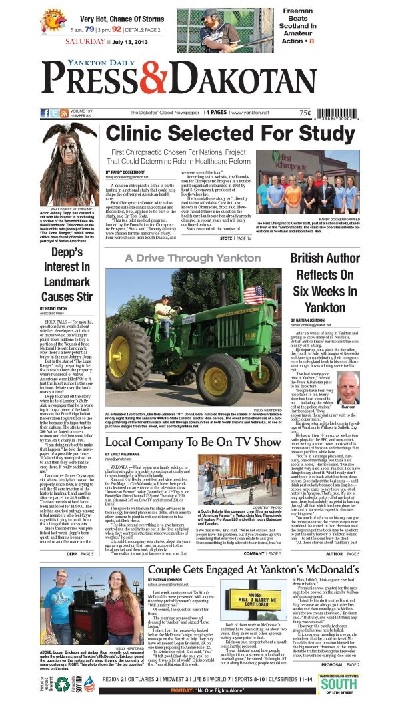
Press & Dakotan page 1A design work
By Andrew Atwal andrew.atwal@yankton.net
March 6, 2012. Spring break.
I’m at a Princeton University vs. University of Pennsylvania basketball game when the news comes in. I have an offer to join the staff at the Press & Dakotan to cover the education beat as a reporter, even though I’m not set to graduate from Michigan State University for another two months.
Without hesitation, I accept the offer, knowing life in South Dakota will be much different than what I have been accustomed to.
After growing up in New Jersey and going to school in Michigan, I became used to the hubbub of large cities and knew I’d be in for a different lifestyle coming all the way out to South Dakota for my first job out of college.
During April 2012, I decided I would come out to check out Yankton and look for an apartment. I quickly realized how nice the town was and how nice the people in the community were. Everyone in the community and at the P&D quickly made me feel right at home and made my transition from the urban to rural much more manageable.
I moved into my apartment in Yankton that Memorial Day weekend, and started at the P&D a few days later. With a lot of help from coworkers and members of the community, I quickly felt at home and was able to build sources within the community.
As time went on, I continued to realize how good of a decision I made to make the move from the urban areas I was used to all the way to the South Dakota rural life.
By the time winter came, I had to take six weeks off of work to deal with surgery and recovery. After that happened, I felt a lot of support from members of the community for my well-being and speedy recovery.
When I arrived back in Yankton in January, the support continued. People would walk up to me seeing how I was feeling and wishing me nothing but the best as my recovery continued in Yankton.
Although my classmates at Michigan State gave me a hard time for making the move to Yankton from the big cities I’m used to, I have felt nothing but love and support from the Yankton community.
Sources that I’ve built within the community, particularly those at the Yankton School District (YSD) and Mount Marty College (MMC), have been honest and willing to speak to me about a number of issues ranging from budget problems, to events, to the hiring of a new superintendent.
However, after more than a year in Yankton with the P&D, it is time for me to say goodbye.
I have accepted a new position close to home in New Jersey that keeps me in the newspaper industry, but working in a new capacity.
Instead of focusing heavily on reporting and page design like I have during the past year in Yankton, I will have an even greater emphasis on page design and social media.
Instead of being a three-hour plane ride from home, I’ll be a two-hour drive from home and within an hour or two of the biggest cities on the East Coast, including New York, Philadelphia, Baltimore and Washington.
I am excited for the change, but will also miss a lot about my time here in Yankton.
I’ll miss the friends I’ve met, sources I’ve built and my job here at the P&D.
Press & Dakotan publisher Gary Wood, managing editor Kelly Hertz and sports editor James Cimburek, all of whom I interviewed with on the phone, took a chance on me fresh out of college and months before I graduated, and I cannot thank them enough for doing so.
I will miss a lot about Yankton and thank everyone for making me feel right at home from the day I moved here up until the time I leave next week.
You can follow Andrew Atwal on Twitter at twitter.com/andrewatwal
Posted: Monday, July 8, 2013 10:31 pm | Updated: 10:33 pm, Mon Jul 8, 2013.
By Andrew Atwal andrew.atwal@yankton.net
At its annual reorganization meeting Monday night, the Yankton School District (YSD) school board elected Jim Fitzgerald as the new president, while re-electing Kathy Greeneway to the vice president position.
Fitzgerald said he’ll enter the presidential post with no set agenda and looks forward to continuing to serve the district in a new capacity on the board.
New school board member Sarah Carda was also sworn to the board with a three-year term.
“Like I said during the elections, I’m really looking forward to learning a lot while serving on the board,” she said.
YSD superintendent Wayne Kindle, attending his first meeting in his new post, recognized outgoing school board member Chris Specht for his 16 years of service to the school district.
“Chris did a lot of good things for the district, staff members and students,” Kindle said. “I want to congratulate him for a good 16 years on the school board.”
Board members also discussed the preliminary 2013-14 school budget, which will be voted on in September.
“State law requires a preliminary budget to be presented in May,” Kindle said. “Law also requires there be a public hearing on the budget, which is what we did today. Budgets must be approved by October.”
The YSD budget includes a one-time money allocation of $284,000 for YSD, which was approved by the Legislature.
The budget also calls for an increase in pay to staff members across the board. However, the Yankton Education Association (YEA) and YSD board members are still negotiating the terms of the pay raise.
“Compared to last year, this budget includes 12 months of health premiums paid for, in comparison to six months last year,” Kindle said. “The budget also calls for an increase of about 35 percent in water spending, due to some issues the City is having with water treatment.”
The preliminary budget also includes a decrease in utility expenses due to a law that allows districts in the state to use parts of the capital outlay fund to pay for utility costs.
YSD business manager Jason Bietz said the district has been able to save money due in part to a few very successful programs.
“The early retirement program has been extremely beneficial to the budget,” he said. “It’s successful in terms of quantifiable payback to the district. In addition to early retirement, we’ve had significant savings through attrition.”
Board members also heard a proposal from Yankton Basketball Incorporated (YBI) about a donation of statistic boards for the Yankton High School (YHS) gym.
Buddy Hovland of YBI said the group wants to make a donation to help the district and gym.
“YBI is currently active in promoting basketball to the youth of the Yankton area,” Hovland said. “We would like to donate stat boards to the district, which would go right next to the big scoreboard in the Summit Center gym. This would bring YHS up to grade with other schools across the area.”
The donation of the boards would cost YBI about $17,000. However, it would cost the district, or another outside group, around $5,000 to install the boards.
Because of the $5,000 cost, board members tabled the proposal to the August school board meeting in hopes of finding an outside group to donate the $5,000 to have the boards installed.
At the end of the meeting, board members met in executive session. No action was expected to be taken.
You can follow Andrew Atwal on Twitter at twitter.com/andrewatwal
Posted: Friday, July 5, 2013 10:00 pm
By Andrew Atwal andrew.atwal@yankton.net
After 16 years on the Yankton School District (YSD) school board, Chris Specht thinks now is a good time for him to say good-bye.
Specht was first elected to the board in 1997 and has served with the board ever since then. Most recently, Specht has served as board president, a position he has been appointed to several times since he was first elected.
Specht’s tenure comes to a close when the board reorganizes for the 2013-14 school year at Monday’s board meeting.
“Back in 1997, I had a 4-year-old and a 2-year-old, and while I was a graduate of Yankton High School (YHS) and believed that the education being offered to students was excellent, I wanted to know more about how schools function and how they operated,” he said. “I really wanted to be able to contribute to the continued success of the district.”
Specht said he thought his experiences with insurance and risk management may have helped him contribute during his time on the board.
“Even though I had that background, I was merely one of five votes. I thought the team and board as a whole, along with administration, worked together well to ensure a quality education continues to be offered to students at the district,” he said. “It was a good team effort.”
The best memories Specht said he had on the board was the interaction with students and staff members during his tenure.
“I was able to interact with students, staff members and administration at board meetings, activities, on a committee and during negotiations,” he said. “I really had a lot of good experience during my time on the board.”
However, Specht has faced numerous challenges while on the board.
“The fight politically for per pupil funding in the state has forced us all to look at public education with less of a focus on student achievement and more of a focus on what this will cost,” he said. “In the end, I don’t think that is beneficial for students.”
Specht’s youngest daughter recently graduated from YHS, said that is a big reason why he felt now was a good time to leave the board.
“My youngest daughter graduating was a factor, but another factor was the fact that after you do something for so many years, you begin to feel like there are other people with newer and fresher ideas who can contribute more to the continued success of YSD,” he said. “Everything runs its course, and I felt it was my time to begin to look for different activities to be a part of.”
Despite being a part of the board for the last 16 years, Specht’s tenure was nearly cut short in 2006.
“I got beat in an election in 2006 by Elizabeth White. There were five people running for two open spots on the board, and I finished in third,” Specht said. “She was sworn in to office that July, but in September, she and her family moved out of town and the board asked me to come back. State law allows for individuals to be appointed to serve out the remainder of that year, then the next year I was elected back to a full three-year term.”
One of the things he said he’s most disappointed about during his time on the board was the second property tax opt-out failing.
“Even with that opt-out failing, I think the board and administration have moved in the direction that the community directed them to go, which includes spending down the health insurance reserves,” Specht said. “However, there is going to come a point where the community will have to decide what kind of education and district they want, due to a lack of state funding for public education.”
Board member Jay Williams said, despite only being on the board for the last two years, he’s enjoyed working with Specht.
“I found Chris to be a thoughtful and knowledgeable school board member,” Williams said. “He is, by far, the most experienced member of the board and we will miss his knowledge of the district issues when his term is over. He has been a dedicated and hard-working advocate for YSD, while remaining sensitive to the needs of the community, district staff members and, most importantly, YSD’s students.”
YSD superintendent Wayne Kindle said he always enjoyed how easy it was to work with Specht.
“Part of Specht’s legacy will be his passion for students and the concern for the well-being of all employees. He believed that a successful school district, like YSD, is a product of all the people who work in the district,” Kindle said. “His impact can be seen through our facilities, academic and activities programs. I will miss his sense of humor, honesty and seeing him volunteer at different events — he was a very dedicated school board member.”
Specht said he plans on spending a lot more time with his youngest daughter this summer before she heads off to college, and will also take time to relax.
“I haven’t looked at other volunteer board opportunities yet, and I’ve never seen them as being a chore or a burden in any respect,” he said. “They’re good opportunities to contribute and learn from others, and I look at them as opportunities to give back.”
Specht said it doesn’t matter to him how he is remembered for his time on the board.
“I tried to contribute and be a team player, and did the best I could to get all the facts before making any decision,” he said.
You can follow Andrew Atwal on Twitter at twitter.com/andrewatwal
Yankton Man And His Border Collie Round Up International Title
Posted: Monday, July 1, 2013 10:16 pm | Updated: 10:59 pm, Mon Jul 1, 2013.
By Andrew Atwal andrew.atwal@yankton.net
“Comebye” is just one of the words Kelly Gale uses to control his dogs when they try to wrangle in sheep, horses and cattle.
Now Gale can add another word: champion.
His success recently netted him a cattle dog title at the first-ever Continental Stock Dog Competition, which was held in Winnipeg, Manitoba, Canada, June 21-23.
Gale and his border collie Bess took home the title, which featured a $2,000 cash prize.
“This is the first time I’ve won an event like this — and I have a lot of friends up in Canada — so it meant a lot to me,” Gale said. “I used to rodeo, and winning this event meant as much to me as anything I’ve ever won. The best dogs from across the United States and Canada compete in that event.”
The competition featured a course in which Kelly had to stand behind a line and have Bess bring cattle through fence gates and other obstacles.
“Bess would have to go around a bend, go through a wide-panel shoot and do it all within just a few minutes,” Gale said. “During the second part of the contest, we can help our dogs go through an obstacle, and I was in the top five going into the second round.”
Gale ranked third going into the third round, which was a short course. Gale said Bess handled the cattle well during that round of competition.
Gale trained Bess in Yankton by building a practice arena outside his house.
“I have Bess bring cattle and sheep around a course I have set up,” he said. “I use my dogs to work cattle out here, but it’s not every day work. Sheep and cattle sharpen Bess like how humans would train an athlete.”
In addition, Gale trains his dogs by exercising them frequently, making sure they’re fed right and on time, and making sure everything is ready to go with the practice courses.
“I incorporate all of my dogs into my work,” he said. “To place in a contest is great, but the real reward is having my dogs help me.”
In order to direct his dogs, Gale uses a series of words that tell the dogs which way to move, and whistles to get the dogs to stop and go.
“Bess has been the smartest dog I’ve ever had,” he said. “Border collies’ natural instinct is to fetch, and they’re able to move herds better than most other dogs.”
Although most of the dogs at the event were border collies, there were several Australian shepherds, as well.
“These dogs will do anything to please their owners,” Gale said. “I’ve sent my dogs out around 3/4-mile here to gather a herd and they’ve been able to do it. They will literally risk their life for their owners.”
Gale said he loved being in Canada for the competition.
“I love the Canadian people and how great they always treat me,” he said. “I’ve worked dogs up there and used to have cattle up there. The people have always been great to me.”
You can follow Andrew Atwal on Twitter at twitter.com/andrewatwal
Posted: Sunday, June 30, 2013 10:08 pm
By Andrew Atwal andrew.atwal@yankton.net
According to the newest Kids Count survey, the news is mixed for children living in South Dakota in 2013.
The new study from the Annie E. Casey Foundation ranked states in several different categories for child well-being.
South Dakota ranked 18th of the 50 states overall and the state improved in the economic and health categories, but declined in the education and family and community categories.
“I think our overall rank is good, though we did drop a little but, the ranking is still good,” said Carole Cochran of South Dakota Kids Count at the Beacom School of Business at USD. “I would like to see us continue to get better and raise into the top 10 eventually.”
Nebraska ranks eighth overall for child well-being and is fourth in economic well-being, 17th in education, 10th in health and 15th in family and community.
Child and teen deaths in South Dakota has dropped dramatically from 2005, when the state had 49 per 100,000 child and teen deaths. This year, that number is at 39.
“Even with that substantial drop, we still rank 48th in the nation in that category,” Cochran said. “So we’re still deeply concerned about that.”
No other state bordering South Dakota ranks that low in teenage and child deaths.
“You need to think that improving this number by 10 percent would mean nine fewer deaths,” she said. “The bulk of those deaths is from unintentional injuries, which includes car crashes, and that can have a big impact on the state.”
A youth and teenage driving task force was put together a few years ago that looked at all data and researched teenage driving in the state.
“This year, there were four bills submitted to the Legislature, and one ended up passing,” Cochran said. “The bill that passed bans teenagers under age 16 from using electronic devices while driving. Research has shown that distracted driving for teens is a big cause of collision and I think having a stronger driver education program would help impact that.”
She added that she hopes the three bills that were not passed during this legislative session are introduced again and get another review.
Despite the poor ranking in child and teen deaths, Cochran said South Dakota fares well in other categories.
“Something that bodes well for the state is that we rank third in economic well-being in the nation,” she said. “Also, teens not working and not in school also dropped from 6 percent in 2008 to 5 percent in 2011. This could be due to a policy change that mandates school attendance in the state up until age 18.”
The health domain ranking for South Dakota also rose from last year.
The state currently ranks 38th in the nation in the health categories, but improved in children without insurance and teens who abuse drugs or alcohol.
South Dakota did not experience any rank change for children in poverty.
“There are still one in five children here living in poverty, which has not changed since 2005,” Cochran said. “However, number-wise, we have 3,000 more children living in poverty today than we did in 2005.”
One thing Cochran said to keep an eye on is low birth weight babies in the state. Between 2005 and 2010, the number rose from 6.6 percent to 6.8 percent. Although she said this is a small number, it is still something to keep an eye on.
Cochran added that she is concerned about fourth graders not being proficient in reading. In 2005, 66 percent of fourth graders were not proficient, dropping to 64 percent in 2011.
New to the Kids Count study this year is the inclusion of more categories.
“I think it’s good that Kids Count changed the way they look at child well-being,” Cochran said. “They went from having 10 indicators to having 16 and then divided those indicators into four different domains. They did this because of increased data available related to child well-being. This allows us to tell which states are doing well and which are lagging behind.”
She added that she would like to see an improvement in more categories going forward, but it takes a team effort to make that possible.
“It takes an effort in communities to look at the indicators and see what we can do. Some things we can fix within our power but other times it takes a policy change or additional funding for different programs that the state has to look at,” Cochran said. “Relative to other states, we’re holding our own. I would have liked to see the overall rank improve, but we did improve on eight of the 16 indicators, with two unchanged. I would like to see improvements on all the categories next time.”
You can follow Andrew Atwal on Twitter at twitter.com/andrewatwal
Officials Cracking Down On Alcohol Infractions On The Water
Posted: Sunday, June 30, 2013 10:05 pm | Updated: 10:08 pm, Sun Jun 30, 2013.
By Andrew Atwal andrew.atwal@yankton.net
Officials from the South Dakota Game, Fish and Parks (GF&P) are cracking down on boaters who operate their vessels while intoxicated.
“Although we have been conducting these operations for a number of years, we’re giving them more publicity now,” said Brandon Gust, law enforcement specialist for the GF&P.
Officials will hold operations with saturation patrols in specific areas. They will also run safety checks out on the waters across the state.
“There is an increased number of people out on the water during the summer and on the Fourth of July, so we’re emphasizing alcohol awareness,” Gust said. “However, we don’t conduct anything different than we normally would with having these checks.”
He added that the checks on the water are not like automobile sobriety checks.
“With cars, each car gets checked — and this is not like that,” Gust said, “We do some checks either from seeing things out on the water or having officers in areas doing safety checks on the ramps. If we come into contact with someone that has been drinking, we’ll address the issue.”
He added that a typical safety check for a boat inspection is either out on the water or at a boat ramp.
“We check for safety equipment on vessels, including life jackets,” Gust said. “We also look for proper boat registration and other items operators need to have on board.”
Gust added that before boaters go out, they should make sure they have everything required by law in the boat, limit their alcohol consumption and have a safe operator on board.
“We have different parts of the state that we take more of an effort to get awareness out there, particularly in bodies of water where alcohol consumption is more prevalent,” he said. “Typically, it seems like once the word gets out about the sobriety checks, the numbers of alcohol violations go down.”
Alcohol violation numbers for boaters have held steady over the past few years, but numbers increased slightly last year due to hot and dry conditions across the state, Gust said.
“With the weather the way it is in South Dakota, the length of the boating season can vary each year based on weather conditions,” he said. “When it is hotter and dry outside, we see more people out on the lakes and rivers.”
Gust said typically alcohol consumption is higher at recreational areas, such as Lewis and Clark Lake, but consumption still occurs at smaller fishing lakes.
He noted that it can be difficult for other boaters to spot a drunk operator on the water.
“It’s tough to tell if someone is operating their vessel drunk,” Gust said. “Boats are free-floating and there are no traffic lanes, so it’s hard to give anything for people to look out for. The biggest thing is that if something looks out of place, careless or is a danger to other people, you should not hesitate to report the vessel operator.”
You can follow Andrew Atwal on Twitter at twitter.com/andrewatwal
Andrew Atwal/P&D | Posted: Sunday, June 30, 2013 10:13 pm

Yankton’s Dogs ‘R’ Us 4-H group held its first Pet Palooza event Saturday at the Yankton County 4-H Grounds. The event featured petting zoos, fingerprinting for youth, a dog show, an appearance by the Yankton Police K-9 unit and pet contests. Animals on site included dogs, cats, alpacas, ponies and this hungry camel, who is shown being fed by a delighted little girl.
Posted: Friday, June 28, 2013 10:00 pm
By Andrew Atwal andrew.atwal@yankton.net
Joe Gertsema is leaving the Yankton School District (YSD) after 22 years, but he’s not leaving education.
Gertsema, whose official last day with the district is Sunday, is now teaching school finance at the University of Sioux Falls as well as an additional course at Dakota Wesleyan University in Mitchell.
“I just started teaching college classes this week, but teaching on the college level has always been on my bucket list,” he said. “Over the course of time as an administrator, I’ve been able to pick up a lot of experience and I’m looking forward to sharing it with aspiring school educators.”
Gertsema announced his resignation last December. He said had been contemplating the decision to resign for about a year and felt that it was a good time for him to leave.
He said it was a privilege to serve as superintendent of YSD.
“My time here went quickly, and I viewed it is an honor to serve here as superintendent,” Gertsema said. “I’m most proud of student achievement during my time as superintendent, but this is the result of many people doing their jobs, including teachers, administrators and other employees — everyone contributes to student success.”
He added that the school board has been good about keeping student achievement a top goal of the district.
School board member Jay Williams said Gertsema has been a “tireless advocate for the Yankton School District.”
“Prior to my election to the school board, I had the opportunity to know him as a parent, with my children in the school system, and as a fellow member of a local service organization and as a friend,” Williams said.
When Gertsema arrived at YSD more than two decades ago, he began working on a project to develop the facilities at the district. He formulated a plan that included a joint relationship between the city and school district that led to the building of the Yankton High School (YHS) and Summit Activities Center.
Williams said that he has always been impressed with Gertsema’s leadership of the school district.
“When it became apparent more than 20 years ago that the district needed a new school to replace the aging middle school, it was Dr. Gertsema’s leadership and efforts that led to building the Summit Center and new high school,” he said. “We built a first-class facility that, not only serves the high school students, but also provides a major recreational facility for the community.”
Williams noted that this creative solution allowed YSD and the city to cooperate in both building the facility and then sharing it.
“This was a major accomplishment that Dr. Gertsema can be very proud of,” he said. “Of course, the project also included renovating the old high school into the new middle school, which has also served our students well for the last 20 years.”
Williams said Gertsema also served in a leadership role with the Yankton Rotary Club.
“As a fellow Rotary member, I watched Gertsema serve as president of the organization,” Williams said. “His unselfish volunteer activities with Rotary and other organizations go largely unnoticed, but they contributed by helping to make Yankton a better place to live.”
YSD school board president Chris Specht said he appreciates the team with which Gertsema surrounded himself.
“Gertsema was able to surround himself with quality leaders and educators,” he said. “If you look at the current administrative team, faculty and staff, he had a hand in hiring the vast majority of them. Those folks work hard to provide quality educational opportunities for students in a safe and well-maintained environment.”
New YSD superintendent Wayne Kindle said he appreciated that Gertsema allowed building principals to run their own schools, while also holding them accountable. Kindle also said Gertsema’s experience was crucial in how he ran the school district.
“Gertsema had many years of experience in education, which led to good problem solving skills related to school issues that came up throughout the school year,” Kindle said. “He was also able to accomplish a lot of good things over the years, including building the Summit Center, which has been an asset to our community and students.”
Kindle added that he enjoyed working for Gertsema over the years.
“Gertsema was a good boss to work for and he wasn’t afraid to tell you if something needed to be changed,” he said. “I appreciate the fact that Gertsema hired me and allowed me to have an opportunity in the Yankton School District.”
Although Gertsema said he’s proud of all of his accomplishments, he’s most proud of being able to see students succeed at YSD.
“Seeing students succeed is the biggest reward for me and it’s why I’ve always been in education,” he said. “I think another thing was the facilities situation at YSD was improved immensely during my time there. Also, being able to continue the academic and activity program tradition the district had before I came in was important to me.”
However, it was not all smooth sailing for Gertsema during his tenure. Two property tax opt-outs failed, and he was also arrested for driving under the influence (DUI) last October, an incident he was forthright about right after it happened. In addition, YSD has faced a declining enrollment and state education cuts that Gertsema has had to deal with over the past several years.
Kindle said one of the things he appreciated most about Gertsema was all he was able to provide students and faculty members of YSD.
“He did a lot of good things for our students and staff here,” Kindle said. “I appreciated it when he would be frank and candid with you, because you always knew the next day was a new day.”
Specht said Gertsema expected faculty members to do their jobs while and expected positive outcomes for students.
“While he had high expectations, he always tried to stay out of the day-to-day operations of the buildings and left that to his administrative team,” Specht said. “During my time on the board, we always had a professional relationships. I believe there was a mutual respect in that I did not try to tell Gertsema how to be superintendent and he did not try to tell me how to be a good board member.”
He added that board members understood their roles with Gertsema in charge and felt as if they could disagree on an issue, but move forward and be able to support decisions made once the votes were counted.
Gertsema said he always took his job at YSD seriously.
“I wish the district, students, staff and board members well,” he said. “Being superintendent at YSD was my job for more than 20 years and I know I’m leaving the district better than I found it. I hope YSD continues to improve and thrive and believe the kids of the district deserve that. I wish Dr. Kindle well. I’ve known him for 20 years and it has been fun contributing to his career.”
You can follow Andrew Atwal on Twitter at twitter.com/andrewatwal
Posted: Tuesday, June 25, 2013 10:29 pm
By Andrew Atwal andrew.atwal@yankton.net
A new study shows that 103,180 people in South Dakota do not know where their next meal will come from. In addition, of those 103,180 people, 36,110 are children.
The Feeding America study also shows that 12.5 percent of the state population will struggle with hunger.
Locally, there are varying levels of people who are “food insecure.” Food insecurity is defined by the USDA as “consistent access to adequate food is limited by a lack of money or other resources at times throughout the year.”
In Yankton County, 10.9 percent of the population is considered food insecure, or 2,450 total people. Of that total, 40 percent fall below the Supplemental Food Assistance Program (SNAP) threshold of 130 percent of the poverty level.
In Bon Homme County, 10.8 percent of the population is deemed food insecure. This percentage is 13.9 percent in Charles Mix County and 15.1 percent in Clay County.
Nearly 14 percent of the Nebraska population deals is food insecure, including 11.3 percent for Knox County and 9.2 percent in Cedar County.
“This is the third study Feeding America has done, going back to the time when the measurement for the need of food assistance was based on just a few factors,” said Matt Gassen, executive director of Feeding South Dakota. “The new approach and formula was created using those few factors and adding in others to have a better determination of the amount of people across the country who are food insecure.”
He added that the term “food insecure” is new, as people are used to using the term “hunger”.
“This is really about the entitlement for every American to have three meals each day,” Gassen said. “If someone is food insecure, it means they don’t know if they can have food for a given meal.”
This study allows officials from across the country to look at food insecurity rates in each county.
“This really helps us identify the areas in South Dakota that have a greater need and we can focus more on those areas,” he said.
South Dakota has experienced a slight increase in the number of people who are food insecure from the last study.
“There are about 1,000 more people in this study who are said to be food insecure,” Gassen said. “However, there has also been an increase in the population of South Dakota. So you could summarize that it’s a natural increase that comes with a greater population base.”
Officials at Feeding South Dakota said the study confirms, to an extent, what they already knew.
“We know that there are a lot of people in the state struggling to make ends meet and put food on the table,” Gassen said. “The study enables us to … see how many meals are being missed and look at data by areas in the state.”
He added that even though there is a large number of people in the state who need food assistance, officials at Feeding South Dakota will not be overwhelmed by the number.
“These statistics are what keep us up at night,” Gassen said. “We want to be able to figure out better and more efficient ways to get food to different areas across the state.”
He said the figure he found most interesting in the study was that the group between 130 and 185 percent of the poverty level makes up about 14 percent of those that are food insecure in South Dakota. However, the number of people who are food insecure jumps up to around 50 percent of those people who are at least 185 percent of the poverty level.
“As a whole, the numbers are significant,” Gassen said. “The percentage breakout tells us different stories and shows that some families are struggling with their incomes, working poor families and people who are struggling with non-liveable wages.”
He noted the fastest growing group of food insecure people in the state could be the working poor and seniors.
“There are a lot of rising costs right now, including food costs, fuel costs, utilities and medications,” Gassen said. “Although these groups might make enough money to survive, in reality they don’t.”
Feeding South Dakota aims to help citizens in a number of different ways, including by running food pantries and food banks.
“We base the food pantry on other organizations’ needs, so the community gets to decide who needs the food assistance. We just provide it,” Gassen said. “The food bank provides and distributes foods to non-profits across the state. However, all of the programs we run have one thing in common — providing food assistance to individuals and families across the state.”
Feeding South Dakota also runs a mobile food pantry program that distributes food straight off the truck to around a dozen communities each year.
“We understand when people are struggling to make ends meet and put food on the table, it could be the result of a number of different factors,” Gassen said. “The solution to that — in simple form — comes from higher paying jobs and education. Some communities also need better access to low-cost meals, and some rural communities don’t even have access to grocery stores, or grocery stores where food is more affordable.”
You can follow Andrew Atwal on Twitter at twitter.com/andrewatwal
 By Andrew Atwal